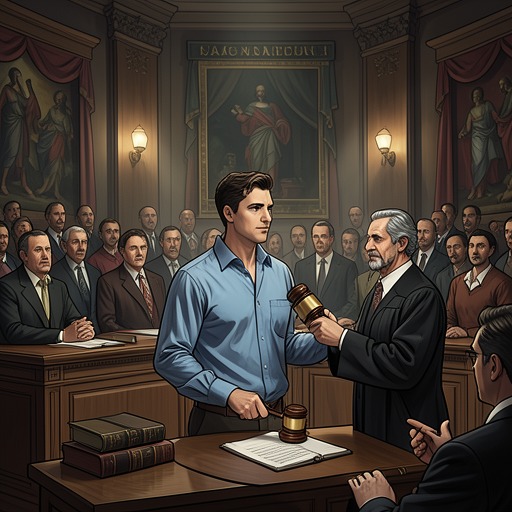
Harrison Smith
In Cold BloodHarrison Smith was the court-appointed lawyer for Dick in the Clutter murder case, and one of two local attorneys assigned to defend the defendants after they reported that they lacked the money to hire counsel. His role developed from reluctant acceptance of the appointment into a sustained effort to secure psychiatric evaluation, test the prosecution’s evidence, and persuade the jury to spare the defendants’ lives. The record also returns to his work after the trial, when he had to account for the defense decisions made under severe evidentiary and local constraints.
Appointment and position
When Judge Roland H. Tate appointed counsel, Arthur Fleming initially resisted the assignment but accepted it as his obligation. Smith, forty-five, six feet tall, a golfer and a high-ranking Elk, accepted with resigned composure, acknowledging that somebody had to do the work and that the task was unlikely to make him popular locally. The contrast in their introductions sets up a defense team with different temperaments: Fleming was seventy-one and a former mayor of Garden City, while Smith was the younger lawyer who would take on several of the more confrontational exchanges in court.
The appointment was made in a community where the prosecution intended to seek the death penalty. Smith therefore represented Dick not only against the charges but in a case where the consequences of conviction were explicitly capital. The defense team discussed whether to seek a change of venue. Fleming argued that moving the trial elsewhere in Kansas would not remove statewide sentiment, and that Garden City’s ministers, including the Clutters’ minister, had spoken against capital punishment. Smith’s subsequent work unfolded against this difficult balance: local pressure was a concern, but the defense also saw possible grounds for mercy within the community.
Psychiatric examinations
Soon after the arraignment, Smith joined a motion asking that the defendants be examined at Larned State Hospital. He told the court that Garden City had no qualified psychiatrists and that Larned was the only nearby facility with specialists able to conduct serious psychiatric evaluations. He had driven there, consulted hospital staff, and learned that examinations would take four to eight weeks; the state institution was willing to begin promptly, without charging the county. His argument emphasized both expertise and practical access to it.
Logan Green, the special assistant prosecutor, opposed the proposal. He argued that Kansas followed the M’Naghten Rule and that the law did not require specially qualified psychiatrists to determine a defendant’s sanity. Smith answered that this was not an ordinary probate proceeding: two lives were at stake, and the defendants deserved assessment by trained and experienced professionals. He also urged the court to take account of psychiatry’s development and the growing attention paid to it by federal courts. Judge Tate did not send the defendants to Larned. Instead, he appointed a three-doctor commission from Garden City. After that commission found neither man mentally disordered, Smith returned to Larned and sought further help. Dr. W. Mitchell Jones, a specialist in criminal psychology who had worked at the state hospital, agreed to examine the defendants and testify if his findings supported the defense.
Trial preparation and courtroom questioning
Eight days before the scheduled March 22, 1960 trial, Smith and Fleming requested a postponement. One stated reason was that Dick’s father was too ill to testify. The other concerned the Clutter estate auction, advertised throughout Garden City for March 21, the day before trial. Smith argued that the notices in shops, banks, restaurants, and the railroad station, together with newspaper and radio advertising, would repeatedly remind prospective jurors of the victims and the case. Judge Tate denied the motion without comment. The exchange shows Smith attempting to address not only evidence in court but also the immediate public setting in which jurors would encounter the trial.
During the trial, Smith cross-examined Floyd Wells, whose information had implicated the defendants. He adopted what the narrator describes as a forced, aggressive manner, asking whether Wells now went by labels associated with informing on others. After the courtroom laughed at Wells’s account of earlier incarcerations, Smith pressed him about why he had waited several weeks after learning of the murders before contacting authorities. He also asked whether Wells had been waiting for a reward, referring to the one-thousand-dollar offer made by the Hutchinson News. Wells denied that a reward had motivated him. Smith’s questioning thus challenged the timing and possible incentives behind the witness’s account, even as Wells replied that he had recognized Dick as guilty because the crime had been carried out as Dick had said it would be.
Defense evidence and plea for mercy
The defense case was brief. The defendants did not testify, and the question of which man had actually killed the Clutter family was consequently not raised at trial. Dick’s father was the first of five defense witnesses. He testified that Dick had been a happy, successful, and considerate boy before a 1950 car accident, and that afterward he seemed like a different person. Smith guided him to describe the changes he had observed, using the testimony to support the defense’s attempt to connect Dick’s past and mental condition to the case. The evidence was limited: the father’s account supplied a claim of changed personality, not a comprehensive psychiatric finding.
Smith also questioned Dr. Jones, establishing his professional background and experience treating patients, including about twenty-five people who had committed murder. The defense thereby put a specialist before the court after the local commission had rejected the claim of mental disorder. But the legal and evidentiary obstacles remained substantial. The defendants had confessed, and, as a later federal judicial opinion observed, the defense had no substantial evidence establishing insanity. The earlier effort to obtain psychiatric examination therefore became part of a larger problem: Smith had sought specialized expertise, but the available proof did not provide a strong basis for an insanity defense.
In closing, Smith made opposition to capital punishment the center of his plea. He argued that the state should not answer the taking of human life by taking life itself, and asked the jury for mercy, presenting life imprisonment as a lesser request. Fleming’s summation drew on religious belief and the sanctity of human life; Smith’s focused more directly on the morality and effects of execution. The prosecutor, Duane West, answered that both defendants were equally guilty regardless of who had fired the shotgun and requested the maximum penalty. The jury returned death sentences. Smith’s appeal for mercy did not change the result, but it made the defense’s final objective unmistakable: with guilt difficult to contest, saving the defendants’ lives was its remaining hope.
Later scrutiny of the defense
Smith’s work was examined again during a later hearing concerning whether the defendants had received adequate representation. The Wichita lawyer Russell Shultz questioned him and Fleming about their preparation, consultations, handling of preliminary proceedings, comments attributed to them in the press, and decision not to seek a change of venue. Fleming explained that local ministers’ opposition to capital punishment, along with a statement by a relative of Mrs. Clutter, had led him to believe the area might contain more people inclined toward leniency than other parts of Kansas. Smith disputed a reporter’s account that he had expressed no doubt about Dick’s guilt and said his concern was only to secure life imprisonment.
A later opinion by three federal judges placed the attorneys’ choices in the circumstances they faced. When appointed, the lawyers knew that both defendants had confessed; a radio taken from the Clutter home and sold in Mexico City had been recovered, and prosecutors possessed further evidence. The defendants had stood mute at arraignment, so the court entered not-guilty pleas for them. The judges also noted the absence of substantial evidence for insanity and characterized the effort to build such a defense from old accident-related injuries and reported symptoms as a weak prospect. In that assessment, the lawyers’ practical hope had been to persuade the court or jury, through some turn of fate, to spare the defendants’ lives. The account does not erase the questions raised about their preparation; it clarifies why Smith’s recorded work repeatedly concentrated on psychiatric evaluation, juror prejudice, and mercy rather than a denial of the crime.